
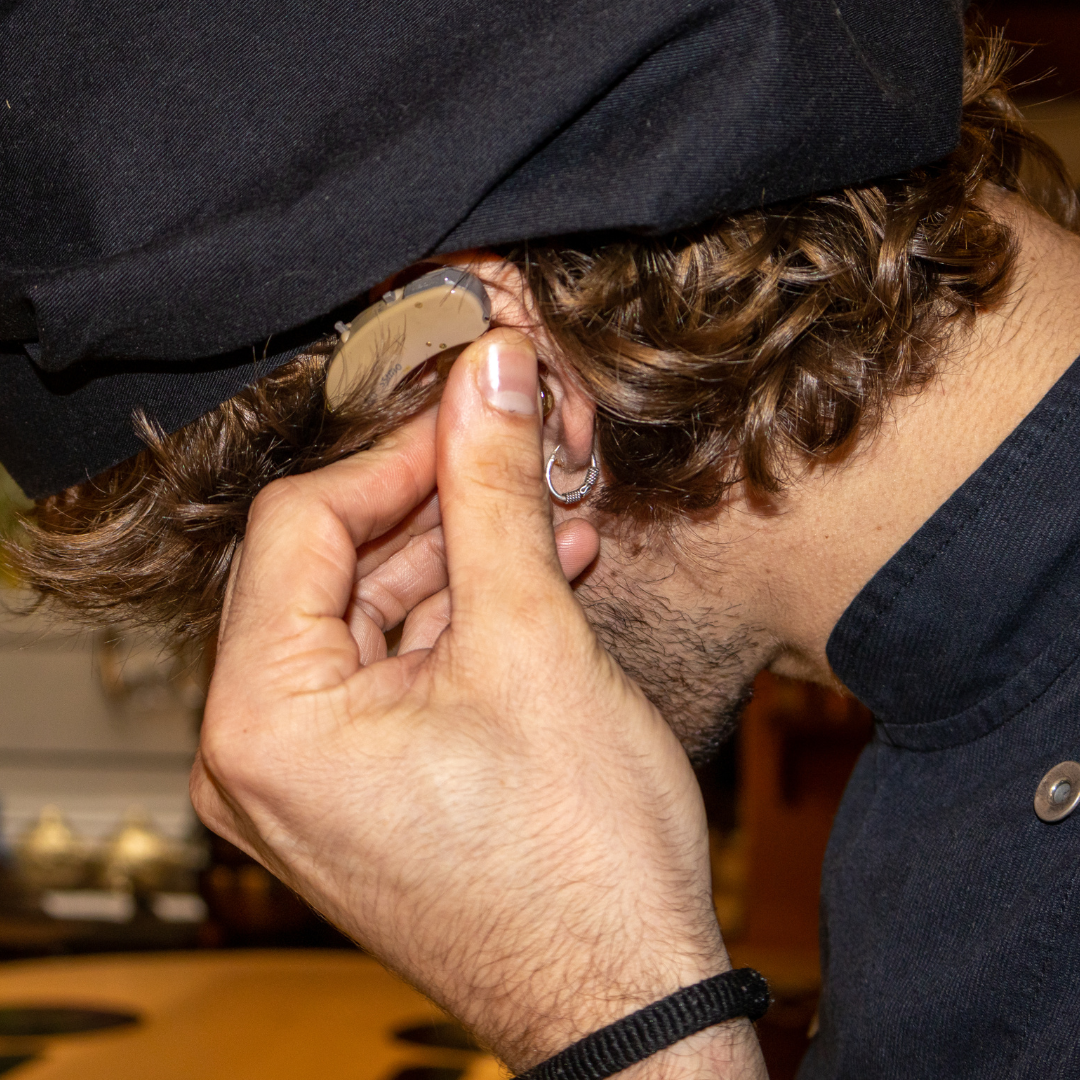
Maintaining dinner dialogue proves demanding when chaotic ambient noise strains your concentration and hearing. Our clinical team can evaluate hearing across quiet settings and background-noise environments to pinpoint specific auditory challenges. When we isolate the root mechanism behind your difficult hearing, we guide you toward customized communication solutions.
Why Everyday Hearing Fails in Busy, Noisy Restaurants
A quiet setting creates an optimal signal-to-noise ratio, ensuring the conversational partner’s voice rises cleanly above ambient sounds. Modern restaurant environments create the complete opposite listening environment. Competing conversations, background music, tableware clatter, and acoustic reflections clash with incoming speech, making auditory processing exceptionally strenuous.
This problem can occur with high-frequency hearing loss, auditory-processing difficulty, or age-and noise-related changes. Cognitive exhaustion, physical fatigue, low ambient lighting, and increased distance from your conversational partner further compound the challenge. Some people have normal results on a basic hearing test but still perform poorly on speech-in-noise testing. Inability to track speech in crowded restaurants merits audiological evaluation even when standard daily hearing sounds completely normal.
Diagnosing High-Frequency Hearing Loss and Clarity Issues
Our diagnostic process starts with a detailed case history reviewing problematic listening scenarios, occupational noise exposure, tinnitus, ototoxic medications, and familial genetics.
Standard pure-tone audiometry gauges the lowest volume thresholds detectable across varying acoustic frequencies via specialized earphones and bone oscillators. High-frequency loss often creates an audiogram pattern in which thresholds become poorer as pitches rise. Supplementary assessments routinely include diagnostic tympanometry to analyze middle-ear status alongside word-recognition testing to determine speech clarity.
Since sound-treated booths cannot replicate the chaos of a crowded dining room, speech-in-noise testing provides critical real-world insight. The test assesses word and sentence discrimination as background acoustic competition intensifies. In combination, these diagnostic metrics reveal whether communication hurdles involve audibility thresholds, speech discrimination, neural noise management, or mixed conditions.
How Do Auditory Processing Disorders Affect Hearing in Adults?
An auditory processing disorder compromises how the central auditory pathways and brain decode incoming acoustic information. The ears may detect tones at expected levels, but the brain may have difficulty organizing competing signals, distinguishing similar speech sounds, or following rapid conversation. Our protocol begins by thoroughly testing peripheral hearing before determining if a specialized central auditory-processing battery or interdisciplinary referral is warranted.
Practical Strategies for Improving Speech Understanding in Noise
Small changes can improve the signal reaching your ears and provide clearer visual cues. Before heading out to eat, select dining spots with quieter acoustic profiles or dine during low-volume hours. Establishments designed with high-walled booths, acoustic wall treatments, heavy fabrics, and carpeting reduce reverberation far better than modern industrial spaces with bare surfaces.
Upon entering the restaurant:
- Request table placement positioned away from dishwashing stations, bustling bars, sound speakers, and celebratory gatherings.
- Situate yourself with a structural wall behind you to minimize distracting ambient noise from behind.
- Face your speaking partners directly in well-illuminated seating to maximize visual speech cues.
- Keep the distance between speakers as short as comfortably possible.
- Angle your stronger-hearing ear toward the primary individual you wish to converse with.
- Ask the speaker to rephrase the missed portion instead of repeating everything.
- Clarify critical details explicitly instead of nodding along or pretending to catch the message.
- Allow yourself a short listening respite when auditory concentration starts to feel drained.
- Request that friends speak with crisp clarity rather than speeding through dialogue.
- Yelling distorts natural speech formants and rarely makes spoken words easier to decipher.
Advanced Technology for Hearing in Background Noise
Choosing the most effective auditory device requires evaluating diagnostic findings, acoustic lifestyle factors, and the presence of hearing loss. Advanced hearing aids utilize beamforming directional microphones, adaptive noise reduction, and specialized restaurant programs to elevate voices directly ahead while suppressing ambient chatter. Realistic expectations are vital, since even advanced hearing devices cannot completely erase background conversational chatter.
Incorporating a dedicated remote microphone provides an even more pronounced improvement in signal-to-noise ratio. The accessory is worn on the lapel or set near the speaker, streaming their voice directly into compatible hearing aids or wireless audio receivers. This targeted setup effectively neutralizes the negative impacts of room distance and interfering background noise.
Alternative assistive hearing tools include:
- Wireless conference table microphones that capture multi-speaker discussions
- Telecoils or hearing-loop systems in equipped venues
- Smartphone live-captioning platforms providing instant speech-to-text visual support
- Modern wireless hearables delivering directional beamforming and sound enhancement
- Decibel-level applications and restaurant rating guides for finding quiet tables
Our audiology staff helps you evaluate options, ensures wireless compatibility, and trains you on operating your chosen equipment.
Clinical Audiology Care for Hearing in Complex Noise
A thorough audiological evaluation expands the diagnostic scope well past simple quiet listening performance. We assess the specific acoustic settings, speaker dynamics, and volume levels that disrupt your hearing to administer targeted evaluations. Your comprehensive workup may involve pure-tone hearing thresholds, middle-ear testing, recorded word recognition, and speech-in-noise measures. Advanced auditory-processing testing can be introduced whenever medical history and baseline assessments justify specialized evaluation.
Hearing changes that present abruptly, affect only one side, or progress rapidly necessitate consultation with an ear, nose, and throat physician. Comprehensive clinical care targets the physiological roots of hearing difficulties rather than simply writing them off as bad restaurant acoustics.
Schedule a Diagnostic Hearing Evaluation Right Away
When dining out causes you to guess at words, detach from family, or experience severe listening exhaustion, book a comprehensive hearing evaluation with us. Our specialists can introduce effective interventions to support your hearing in noisy environments via precision hearing aid fittings, assistive devices, or audiological rehabilitation.
Get in touch with our team to request an appointment and rediscover confident, stress-free restaurant conversations.